

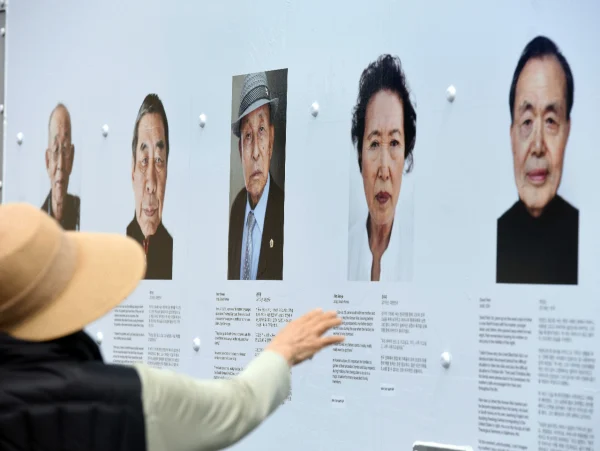

사진/ © Viorel Florescu – USA TODAY Network. Photo of a mobile exhibit of photographs of divided family members by Laura Elizabeth Pohl at the Fort Lee Public Library on May 11, 2018
For Korean Americans with family members still in North Korea, reunification has long been an unfulfilled hope.
Although 21 rounds of inter-Korean family reunions have taken place since 2000, Korean Americans who are U.S. citizens were excluded from those opportunities, as the programs were limited to South and North Korean nationals.
That gap has now been addressed legislatively.
As part of the Fiscal Year 2026 National Defense Authorization Act (NDAA), Congress has formally enacted the Korean American Divided Families National Registry Act, marking a major milestone for the Korean American community and decades-long advocacy efforts.
From Advocacy to Law
The legislative breakthrough builds on earlier efforts during the 117th Congress, when language from the Divided Families Reunification Act (H.R. 1771) was incorporated into the FY2022 NDAA. That provision required the U.S. State Department’s North Korea Human Rights Special Envoy to submit semiannual reports to Congress and explore virtual reunions using video technology.
In the 118th Congress, lawmakers introduced standalone legislation to establish a national registry of Korean American divided families. While the bill did not advance before the session ended, advocates remained focused on reintroduction.
With the start of the 119th Congress, momentum returned.
The registry legislation was reintroduced as H.R. 1273 / S. 555, led in the House by Rep. Suhas Subramanyam (D-Va.), with Rep. Young Kim, the only Korean American Republican in Congress, serving as lead bipartisan co-sponsor. In the Senate, Sens. Tim Kaine (D-Va.) and Ted Cruz (R-Tex.) joined as co-sponsors, creating rare bipartisan alignment in both chambers.
Recognizing the difficulty of passing community-based human rights legislation as a standalone bill, advocates pursued a strategy to include the registry provision in the NDAA — a must-pass measure.
That strategy succeeded.
On Dec. 18, 2025, Congress passed the NDAA in both the House and Senate, with the Korean American Divided Families National Registry officially enacted as an accompanying provision.
Key Provisions of the Law
The new law establishes a permanent federal framework with two core mandates.
First, under the direction of the Secretary of State, the North Korea Human Rights Special Envoy — or a designated senior official — must prepare for future reunions by collecting and maintaining information on Korean Americans with immediate family members in North Korea. This includes preparation for both in-person and virtual reunions through a confidential, non-public national registry.
Second, the law requires that if direct U.S.–North Korea dialogue occurs, the Secretary of State must raise the issue of Korean American divided families as part of official negotiations. Progress must also be reported to Congress through existing reporting requirements under the North Korean Human Rights Act.
Advocates say this provision ensures the issue remains institutionally embedded, regardless of changes in administration.
“The registry will not disappear with a new president,” one advocate said. “It guarantees that divided families remain part of U.S. policy discussions with North Korea.”
Grassroots Advocacy at the Core
Community leaders emphasize that the law’s passage was the result of sustained grassroots engagement.

Organizations such as Divided Families USA and the Korean American Divided Families Committee, along with national umbrella groups including the Korean American Grassroots Conference (KAGC), played a central role in drafting, lobbying and coalition-building.
KAGC worked closely with the offices of Reps. Subramanyam and Kim during the bill’s drafting phase, helped recruit bipartisan co-sponsors, and facilitated direct outreach to congressional offices. Student delegates participating in national advocacy conferences also met directly with House and Senate offices to urge support for the legislation.
Advocates say the effort underscores the importance of sustained civic participation.
“From concept to legislative language, to member outreach and final passage, this was driven by grassroots organizing,” a KAGC representative said. “This is why maintaining a permanent presence in Washington matters.”
For Korean Americans who have waited decades to reconnect with parents, siblings or relatives they may never see again, the law does not guarantee reunions — but it creates a pathway.
More importantly, advocates say, it ensures that their stories are no longer invisible in U.S. foreign policy.
“This is about dignity, recognition and preparedness,” one organizer said. “The door is finally open.”








![[2026 중간선거] 내 주변 투표소 어디? … 주소 입력하면 가까운 투표소 확인](https://texasn.com/wp-content/uploads/Screenshot-2026-10-16-at-11.25.53-AM-120x86.png)