


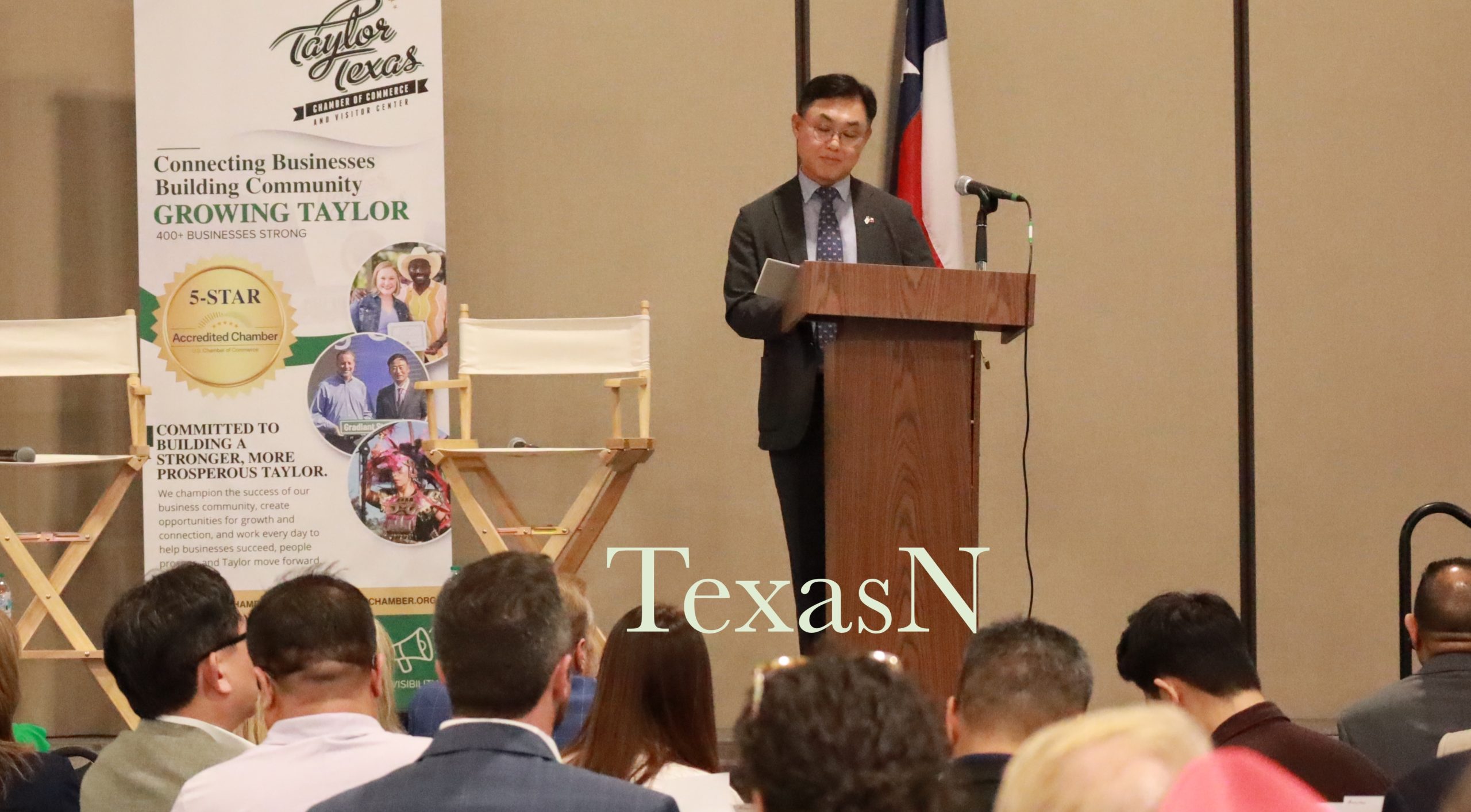

[Bonyoung Koo, president of Samsung Austin Semiconductor and corporate executive vice president of Samsung’s Foundry Division said the Austin and Taylor campuses generated $10.9 billion in regional economic activity in 2025 and supported 28,746 direct and indirect jobs. Those jobs accounted for approximately $2 billion in wages. Photo by TexasN]
- Samsung says its Austin and Taylor campuses generated $10.9 billion in regional economic activity in 2025.
- Korea-Texas cooperation is expanding from semiconductors into AI, data centers, power, water infrastructure and finance.
- Korean companies face unexpected property taxes, permitting delays and limited U.S. credit histories.
- Business leaders say predictable timelines and dedicated points of contact matter as much as financial incentives.
[TAYLOR, Texas = TexasN] Samsung Electronics’ massive semiconductor investment is reshaping the economic landscape of Taylor and the wider Central Texas region.
What began with the construction of semiconductor manufacturing facilities is developing into a broader Korea-Texas industrial ecosystem encompassing materials and equipment suppliers, banking, power infrastructure, water management, artificial intelligence and data centers.
But turning large capital commitments into production and long-term employment will require the region to address a series of “soft-landing” obstacles, business leaders said. Those include shortages of skilled workers, access to reliable power and water, complicated permitting procedures and the lack of U.S. credit histories among newly established companies.
Those issues were discussed at the 2026 Central Texas-Korea Summit, held Aug. 26 at the Williamson County Expo Center.
The Greater Austin Asian Chamber of Commerce, the Greater Taylor Chamber of Commerce and the Hutto Area Chamber of Commerce hosted the event. Representatives from Samsung Electronics, the Korea International Trade Association, K-water, Woori America Bank, Gachon University, local governments and economic development organizations participated.
The program focused on semiconductors, energy, smart infrastructure, supply chains, finance and workforce development.
Samsung says Austin and Taylor investment has reached $34.8 billion
Bonyoung Koo, president of Samsung Austin Semiconductor and corporate executive vice president of Samsung’s Foundry Division, said Samsung has invested $34.8 billion in its Austin and Taylor campuses since 1996.
Samsung selected Austin as a U.S. semiconductor manufacturing location three decades ago. In 2021, the company announced plans to build a new $17 billion advanced foundry in Taylor.
Koo said the Austin and Taylor campuses generated $10.9 billion in regional economic activity in 2025 and supported 28,746 direct and indirect jobs. Those jobs accounted for approximately $2 billion in wages.
The Taylor facility has moved beyond its large-scale construction phase and into equipment installation and operational preparation. Samsung plans to begin operations by the end of 2026, followed by volume production in 2027.
At the height of construction, 62 cranes were operating simultaneously at the Taylor site, which used more than 260 million pounds of steel.
The plant will employ extreme ultraviolet lithography technology required to manufacture advanced, leading-edge semiconductors. Koo said Samsung chips are used across industries including automotive technology, AI and telecommunications.
“Samsung’s presence in Central Texas began 30 years ago, but this is still only the beginning,” Koo said, emphasizing the need for continued cooperation among schools, universities, suppliers and local governments.
The ‘Samsung effect’ extends into power and energy
Kyung-Eun Lee, consul general of the Republic of Korea in Houston, said Samsung’s Taylor project is attracting competitive Korean semiconductor materials and equipment companies to the Texas market.
Austin and Taylor have the potential to become a globally significant semiconductor hub supported by a strong supply chain, Lee said.
The economic relationship is also moving beyond chip production.

Texas electricity demand is rising rapidly as AI computing and data center development accelerate. Korean power and energy companies are consequently evaluating business and investment opportunities across the state, Lee said.
Semiconductor fabrication plants and data centers both require significant amounts of electricity and a dependable water supply. That creates additional opportunities in power generation, grid infrastructure, water treatment and renewable energy.
Lee proposed three steps to expand economic cooperation between Korea and Texas: establishing a one-stop support system for Korean businesses, conducting more proactive investment outreach and helping Texas companies enter the Korean market.
Small and midsize Korean businesses entering the United States for the first time need coordinated assistance with permits, taxes, hiring, banking and the relocation of employees and their families, she said.
Lee also suggested that Texas consider establishing a business office in Seoul to present the state’s investment opportunities directly to Korean companies.
Williamson County expects thousands of new jobs
Williamson County Judge Steve Snell said an estimated 300 to 500 Korean companies currently operate in Texas. South Korea has emerged as one of the state’s leading sources of foreign direct investment, he said. Samsung’s expansion is generating demand not only for semiconductor suppliers but also for construction firms, real estate developers, banks, restaurants, health care providers, educational institutions and other local businesses.
Snell identified the shortage of skilled workers as one of the region’s most pressing economic challenges. “Thousands of jobs are coming,” Snell said. “Workforce development has to be a priority.”
The region must establish a pipeline through which local students can attend nearby colleges or technical programs and then secure well-paying jobs in their home communities, he said.
Samsung has offered paid internships to Taylor Independent School District students for the past five years, with about 24 students participating each year. More than 100 students have joined the program since 2022.
Samsung highlighted one former intern who received an offer for a full-time technical position before completing high school.
The company also works with Austin Community College, the University of Texas at Austin, Texas A&M University and other institutions on semiconductor education and workforce-development programs.
Expert panel examines barriers to Korean investment
Mark Duval, president and CEO of the Greater Austin Asian Chamber of Commerce, moderated a panel examining the economic ecosystem developing around Korean investment in Central Texas.
Panelists included In-Bae Kim, a professor with Gachon University’s Semiconductor Education Excellence Initiative; Joong-Mo Kim, senior vice president of Woori America Bank; Kyung-Hoon Kim, chief representative of the KITA Dallas Center; and Jun-Han Yun, general manager of K-water’s Global Cooperation Department.
They discussed the practical challenges Korean companies face when entering Central Texas, including taxes, financing, labor availability, power and water capacity, regulatory procedures and differences in business culture.
Property taxes can become an unexpected cost
Kyung-Hoon Kim said Texas remains highly attractive because it does not impose a traditional state corporate income tax. Korean companies, however, can face substantial local property taxes they may not have anticipated.
Those taxes can apply not only to buildings but also to manufacturing machinery, equipment and property improvements. As a result, the actual cost of operating a Texas facility may be higher than initial estimates prepared in Korea. Kim identified several recurring obstacles: Local property taxes on factories and manufacturing equipment, The reliability and availability of industrial power
, Water supplies for large manufacturing operations, Shortages of skilled technicians outside major metropolitan areas, Permitting and approval processes that take longer than expected, Differences between Korean and U.S. contracting and decision-making practices
“The opportunity is real, but so are the challenges,” Kim said. “The companies that prepare are the ones that succeed here.”
Korean companies often make decisions quickly and value flexibility based on relationships and trust. U.S. business practices generally require roles, responsibilities and risk allocations to be defined more explicitly in written contracts.
Companies that fail to understand those differences can encounter delays, higher costs and conflicts with vendors or business partners, Kim said.
Limited U.S. credit histories create financing obstacles
Joong-Mo Kim of Woori America Bank said Korean companies entering the United States frequently encounter unexpected difficulties when opening corporate bank accounts and obtaining financing.
To establish an account, authorized signers generally need appropriate immigration status, valid identification and a verifiable physical business address in the United States.
The financing challenge often becomes more significant once construction or operations begin.
A newly formed U.S. subsidiary may need substantial working capital but have no domestic credit history, making it difficult to qualify for a conventional bank loan. Woori America Bank can evaluate the financial strength and banking relationships of a company’s Korean parent when considering financing for its U.S. subsidiary, Kim said.
The bank can also consider an employee’s financial history in Korea when providing credit cards, mortgages and other personal banking services to expatriate workers.
The arrival of Korean-affiliated banks in the Austin area reflects growing demand for corporate and consumer financial services as Samsung suppliers, employees and their families relocate to Central Texas.
Universities and industry operate at different speeds
In-Bae Kim of Gachon University said the region must address the gap between the rapid pace of semiconductor innovation and the slower process of updating university curricula. Semiconductor technology evolves quickly, while universities often need more time to redesign programs, obtain new equipment and introduce specialized training.
Companies should regularly communicate their technical and workforce needs to universities, Kim said. Academic institutions can then incorporate those requirements into their curricula and training programs. He also called for expanded student and faculty exchanges between universities in Korea and Texas.
The goal should be to prepare engineers with the technical skills and international perspective needed to work across major semiconductor markets, including the United States, Korea, Taiwan and Japan, Kim said.
K-water sees role for digital water management
Jun-Han Yun of K-water said water is an essential resource supporting the development of semiconductors, data centers and other advanced industries.
K-water could contribute to sustainable growth in the Austin metropolitan area and Williamson County through digital water-management solutions and financing tools, Yun said. He called for more frequent technical and policy exchanges, stronger mutual understanding and the development of specific collaborative projects.
As semiconductor plants and data centers expand, access to water is becoming as important as electricity in industrial site-selection decisions. Samsung’s investment could therefore create new markets involving water treatment, reuse systems and smart water-management infrastructure.
Predictable timelines may matter more than incentives
Panelists said tax abatements and other financial incentives alone are not enough to attract and retain Korean investment. Companies also need to know how long permitting, utility connections and site-development approvals will take.
Kyung-Hoon Kim recommended that local governments and economic development organizations assign a dedicated point of contact for Korean companies.
That representative could coordinate incentives, permitting, power and water access, hiring and the relocation needs of employees and their families. Such a system would reduce uncertainty for companies entering the U.S. market for the first time.
“Korean companies do not expect every process to move at lightning speed,” Kim said. “What they need is a realistic timeline and consistent communication.” Kim also urged local companies to respond promptly to requests for information and pricing. Slow responses can weaken the momentum behind an investment or potential contract.
Texas businesses should seek to become long-term partners willing to help solve unexpected problems, rather than viewing the relationship as complete once a contract is signed, he said.
Taylor’s next competition will take place outside the factory
Taylor’s economic future can no longer be measured solely by whether Samsung completes its semiconductor factory.
As advanced chip production begins, follow-on investment is expected across semiconductor materials and equipment, logistics, electricity, water treatment, banking, housing, health care and education. But the same investment could increase operating costs and development pressures if supplies of power, water, skilled labor and housing fail to keep pace with industrial expansion.
Summit participants also emphasized the need for a two-way economic relationship. While Korean companies continue investing in Texas, Texas businesses should pursue opportunities in Korea’s AI, robotics and energy markets. Samsung’s 30-year presence in Austin established Central Texas as a semiconductor manufacturing center. Its Taylor expansion is now testing whether the region can build a complete industrial ecosystem around that foundation.
Whether Central Texas remains primarily a U.S. production base for Korean companies or becomes a global hub connecting semiconductors, AI, energy and infrastructure may ultimately depend less on the amount of capital invested than on the region’s ability to deliver workers, utilities, financing and predictable government processes.
Copyright © 2026 TexasN. All rights reserved. Unauthorized reproduction or redistribution is prohibited.
Catherine Wahrmund amiangs0210@gmail.com








![[2026 중간선거] 내 주변 투표소 어디? … 주소 입력하면 가까운 투표소 확인](https://texasn.com/wp-content/uploads/Screenshot-2026-10-16-at-11.25.53-AM-120x86.png)